Tuesday, 1 January 2013

2013 Challenges

Here's how I'm faring with the challenges I've signed up for this year :)

Aussie Author Challenge - January 1st, 2013 - December 31st, 2013
- Tourist Level (read three books by two different Australian writers)

1) Seven Types of Amiguity by Elliot Perlman
2) The Timeless Land by Eleanor Dark
3) The Chant of Jimmie Blacksmith by Thomas Keneally
4) Happy Valley by Patrick White
5) My Blood's Country by Fiona Capp

Independent Foreign Fiction Prize 2013 Longlist
1) Traveller of the Century by Andres Neuman
2) The Murder of Halland by Pia Juul 
3) Cold Sea Stories by Paweł Huelle
4) Dublinesque by Enrique Vila-Matas
5) The Sound of Things Falling by Juan Gabriel Vásquez
6) A Death in the Family by Karl Ove Knausgård
7) The Detour by Gerbrand Bakker
8) HHhH by Laurent Binet
9) Silent House by Orhan Pamuk
10) Trieste by Daša Drndić
11) Black Bazar by Alain Mabanckou
12) Bundu by Chris Barnard
13) In Praise of Hatred by Khaled Khalifa
14) The Fall of the Stone City by Ismail Kadare
15) The Last of the Vostyachs by Diego Marani
16) Satantango by László Krasznahorkai 

Japanese Literature Challenge 7 - June 1st, 2013 - January 31st, 2014
- Read a work of Japanese literature!
1) American Stories by Nagai Kafu
2) Sixty-Nine by Ryu Murakami
3) We, the Children of Cats by Tomoyuki Hoshino
4) Milky Way Railroad by Kenji Miyazawa
5) Snakes and Earrings by Hitomi Kanehara
6) The Name of the Flower by Kuniko Mukoda 
7) Lonely Hearts Killer by Tomoyuki Hoshino
8) From the Fatherland, with Love by Ryu Murakami 
9) The Nihon-ryōiki by Kyōkai
10) Kitchen by Banana Yoshimoto (link is to 2009 review) 
11) Bullfight by Yasushi Inoue
12) Kusamakura by Natsume Soseki (link is to 2010 review)
13) Snow Country by Yasunari Kawabata (link is to 2011 review)
14) Shipwrecks by Akira Yoshimura
15) The Frontier Within by Kobo Abe
16) Modern Japanese Stories - An Anthology by Ivan Morris (ed.)
17) The Diving Pool by Yoko Ogawa
18) Nip the Buds, Shoot the Kids by Kenzaburo Oe
19) hardboiled \ hard luck by Banana Yoshimoto
20) Deep River by Shusaku Endo
21) A True Novel by Minae Mizumura
22) Light and Dark by Natsume Soseki
23) Norwegian Wood by Haruki Murakami

German Literature Month - November 2013
- Read a work of German-language literature!
1) Austerlitz by W.G. Sebald
2) Nichts als Gespenster (Nothing but Ghosts) by Judith Hermann
3) Holzfällen (Woodcutters) by Thomas Bernhard
4) Was bleibt (What Remains) by Christa Wolf
5) Wellen (Waves) by Eduard von Keyserling
6) Božena by Marie von Ebner-Eschenbach
7) Wir Fliegen (We're Flying) by Peter Stamm
8) Die Angst des Tormanns beim Elfmeter (The Goalie's Fear at the Penalty Kick ) by Peter Handke
9) Professor Unrat (The Blue Angel) by Heinrich Mann
  - Part One, Part Two, Part Three
10) Leonardos Hände (Leonardo's Hands) by Alois Hotschnig

2013 Reading List

Click on the link to read the review :)

130) Deep River by Shusaku Endo
129) hardboiled \ hard luck by Banana Yoshimoto
128) Nip the Buds, Shoot the Kids by Kenzaburo Oe
127) The Diving Pool by Yoko Ogawa
126) Modern Japanese Stories - An Anthology by Ivan Morris (ed.)
125) The Frontier Within by Kobo Abe
124) Shipwrecks by Akira Yoshimura
123) Blinding (Part One) by Mircea Cărtărescu
122) The Devil's Workshop by Jáchym Topol
121) Brief Loves that Live Forever by Andreï Makine
120) Beauty on Earth by Charles-Ferdinand Ramuz
119) Uppsala Woods by Álvaro Colomer
118) The Inflatable Buddha by András Kepes
117) The Miracle Cures of Dr. Aira by César Aira
116) The Thousand Autumns of Jacob de Zoet (link is to 2010 review)
115) The Seamstress and the Wind by César Aira
114) Leonardos Hände (Leonardo's Hands) by Alois Hotschnig
113) Professor Unrat (The Blue Angel) by Heinrich Mann (Part One, Part Two, Part Three)
112) Nocturnes by Kazuo Ishiguro (link is to 2010 review)
111) Die Angst des Tormanns beim Elfmeter (The Goalie's Fear at the Penalty Kick) by Peter Handke
110) The American Senator by Anthony Trollope
109) Wir Fliegen (We're Flying) by Peter Stamm
108) Buying a Fishing Rod for my Grandfather (link is to 2009 review)
107) Mrs. Dalloway by Virginia Woolf (link is to 2009 review)
106) Božena by Marie von Ebner-Eschenbach
105) Wellen by Eduard von Keyserling
104) Snow Country by Yasunari Kawabata (link is to 2011 review)
103) My Blood's Country by Fiona Capp
102) Kusamakura by Natsume Soseki (link is to 2010 review)
101) Was bleibt (What Remains) by Christa Wolf
100) Holzfällen (Woodcutters) by Thomas Berhard
99) Bullfight by Yasushi Inoue
98) Chasing the King of Hearts by Hanna Krall
97) Nichts als Gespenster (Nothing but Ghosts) by Judith Hermann
96) Kitchen by Banana Yoshimoto (link is to 2009 review)
95) Happy Valley by Patrick White
94) The Swimmers by Joaquín Pérez Azaústre
93) Cocaine by Pitigrilli
92) The Story of a New Name by Elena Ferrante
91) Bariloche by Andrés Neuman
90) Le Colonel Chabert by Honoré de Balzac
89) Austerlitz by W.G. Sebald
88) A Man in Love by Karl Ove Knausgaard
87) Shades of the Other Shore by Jeffrey Greene
86) Ballade Nocturne by Gao Xingjian
85) High Tide by Inga Ābele
84) The Nihon-ryōiki by Kyōkai
83) The Foxes Come at Night by Cees Nooteboom
82) The Sorrow of Angels by Ján Kalman Stefánsson
81) Open City by Teju Cole 
80) Sommerhaus, später (Summerhouse, Later) by Judith Hermann (link is to 2012 review)
79) From the Fatherland, with Love by Ryu Murakami
78) Under this Terrible Sun by Carlos Busqued
77) Traveller of the Century by Andrés Neuman (link is to 2012 review)
76) The Missing Year of Juan Salvatierra by Pedro Mairal
75) Multiples by Adam Thirlwell (ed.)
74) Ghosts by César Aira
73) Conversation in the Cathedral by Mario Vargas Llosa
72) Days in the History of Silence by Merethe Lindstrøm
71) Lonely Hearts Killer by Tomoyuki Hoshino
70) 70% Acrylic 30% Wool by Viola Di Grado
69) Heaven and Hell by Jón Kalman Stefánsson
68) In Translation by Esther Allen and Susan Bernofsky (eds.)
67) All Dogs Are Blue by Rodrigo de Souza Leão
66) The Name of the Flower by Kuniko Mukoda
65) Der Zauberberg (The Magic Mountain) by Thomas Mann
64) The Aleph (and The Maker) by Jorge Luis Borges
63) An einem Tag wie diesem (On a Day Like This) by Peter Stamm
62) animalinside by László Krasznahorkai
61) Diplomat, Actor, Translator, Spy by Bernard Turle
60) Three Strong Women by Marie NDiaye
59) A Handful of Sand by Marinko Koščec
58) Distant Star by Roberto Bolaño
57) Rituals by Cees Nooteboom
56) My Brilliant Friend by Elena Ferrante
55) The Chant of Jimmie Blacksmith by Thomas Keneally
54) Varamo by César Aira
53) The Infatuations by Javier Marías
52) Professor Borges by Jorge Luis Borges
51) Stone upon Stone by Wiesław Myśliwski
50) The Twin by Gerbrand Bakker
49) Snakes and Earrings by Hitomi Kanehara
48) Milky Way Railroad by Kenji Miyazawa
47) We, the Children of Cats by Tomoyuki Hoshino
46) Blindness by José Saramago
45) Sixty-Nine by Ryu Murakami
44) The Feast of the Goat by Mario Vargas Llosa
43) American Stories by Nagai Kafu
42) The Savage Detectives by Roberto Bolaño
41) Mother Departs by Tadeusz Różewicz
40) Fictions by Jorge Luis Borges
39) The Light and The Dark by Mikhail Shishkin 
38) A Heart So White by Javier Marías
37) Popular Hits of the Showa Era by Ryu Murakami
36) Dublinesque by Enrique Vila-Matas (link is to 2012 review)
35) Satantango by László Krasznahorkai
34) Blue Bamboo by Osamu Dazai
33) Tomorrow Pamplona by Jan van Mersbergen (link is to 2011 review)
32) Raised from the Ground by José Samarago
31) The Timeless Land by Eleanor Dark
30) Meer der Tusche (Sea of Ink) by Richard Weihe
29) The Cape (and Other Stories from the Japanese Ghetto) by Kenji Nakagami
28) Seven Types of Ambiguity by Elliot Perlman
27) Contemporary Brazilian Short Stories by Word Awareness (ed.)
26) The Last of the Vostyachs by Diego Marani
25) The Fall of the Stone City by Ismail Kadare
24) In Praise of Hatred by Khaled Khalifa
23) Bundu by Chris Barnard
22) Black Bazar by Alain Mabanckou
21) Trieste by Daša Drndić 
20) Silent House by Orhan Pamuk
19) HHhH by Laurent Binet
18) The Detour by Gerbrand Bakker
17) A Death in the Family by Karl Ove Knausgaard
16) The Sound of Things Falling by Juan Gabriel Vásquez
15) White Masks by Elias Khoury
14) Stone in a Landslide by Maria Barbal
13) The Way We Live Now by Anthony Trollope
12) The Queen of Spades by Alexander Pushkin
11) The Iraqi Christ by Hassan Blasim
10) Rustic Baroque by Jiří Hájíček
9) Maidenhair by Mikhail Shishkin
8) Phantom Lights by Teru Miyamoto
7) Radetzkymarsch (The Radetzky March) by Joseph Roth
6) Shi Cheng - Stories of Urban China by Comma Press
5) The Investigation by Philippe Claudel
4) Das Muschelessen (The Mussel Feast) by Birgit Vanderbeke
3) War and Peace by Leo Tolstoy
2) The Briefcase by Hiromi Kawakami
1) The Old Capital by Yasunari Kawabata

Sunday, 30 December 2012

The 2012 Tony's Reading List Awards

Welcome to the fourth annual Tony's Reading List Awards, a time for me to look back at the year's reading and sort through the winners and the grinners, the dull and the dreary, the terrific and the terrible - you get the drift (if you'd like to look back at what happened in 2009, 2010 and 2011, be my guest!).

There are a number of awards to be handed out this evening, and I'll be commenting all the while on little interesting stats about my reading year, so let's get on with it, shall we?  Drum roll, please ;)

*****
As always, the first prize up is 2012's Most-Read Author Award - and the winner is:

1) Anthony Trollope (4)
2) Sjón (3)

Trollope takes home the gong for the third consecutive year - well done, sir!
The lack of contenders here is because my cut-off point was three books by one writer, and only two managed to fit that criteria this year.  This is due to a much wider spread of reading this year and can also be seen in the results of my next category...

*****
...which is the Most-Read Country Award!

1=) Germany (18)
1=) Japan (18)
3) England (17)
4) Iceland (9)
5) Australia (7)

In a hard-fought battle (with a much wider field of participants), Germany retains the crown it wrested from England last year - but only just.  Japan was very close, and if the year had included January 2013, we may have had a new champion :)  Stop the Press!  My reading in preparation for January in Japan since writing this post sent J-Lit surging up the charts to share equal billing at the top of the list!

Looking at my original language stats, it's clear to see that my focus shifted even more clearly to translated fiction this year.  Of the 125 books read, just 30 were originally published in English, meaning that a staggering 95 (of which I read 27 in the original language) were originally written in a foreign language.  I'm fairly sure that this is a trend which will continue into 2013 and beyond...

*****
It's now time to hand out the individual honours, and one of the highlights of the literary calendar round these parts is the bestowal of the Golden Turkey Award.  This highly-coveted honour is given to the book which, in my very personal, most subjective opinion, was the biggest waste of my precious reading time over the past twelve months.  And the nominees are: 


The winner (of course) is the truly awful Please Look After Mother, one of the first books I read this year, and without doubt the one I really wish I hadn't bothered with... 

*****
Let's move on now to more pleasant affairs, namely the year's good books.  Each month, in my wrap-up post, I nominate a book or two as my recommendation, and these books form my longlist for the Book of the Year.  This year's nominees (links to my reviews) are:

January - Carpentaria by Alexis Wright
February - In Zeiten des abnehmenden Lichts (In Times of Fading Light) by Eugen Ruge
March - The Unconsoled by Kazuo Ishiguro
April - The Stranger's Child by Alan Hollinghurst
May - Die Blechtrommel (The Tin Drum) by Günter Grass
June - Once Were Warriors by Alan Duff
and Don Quixote by Miguel de Cervantes
July - Petersburg by Andrei Bely
and Dublinesque by Enrique Vila-Matas
August - Independent People by Halldór Laxness
September - A l'ombre de jeunes filles en fleurs (Within a Budding Grove) by Marcel Proust
October - Stone Tree by Gyrðir Elíasson
November - Berlin Alexanderplatz by Alfred Döblin
DecemberThe Old Man and his Sons by Heðin Brú
and My Brilliant Career by Miles Franklin

The fifteen books on the list come from nine different countries, with Germany's three nominations topping the list.  Australia, England, Spain and Iceland all provided two nominees, while books from Russia, France, New Zealand and the Faroe Islands(!) round out the selection.

In the first three years of the blog, I cheated massively by choosing a series as my pick for the year, but this year I am determined to stick my neck out.  Of the fifteen books above, five stood out enough to make it onto my shortlist:

The Unconsoled
Petersburg
Dublinesque
Independent People
Berlin Alexanderplatz

Finally, after lengthy deliberations (and some rather vicious exchanges) in the jury room, a winner was chosen.  The Tony's Reading List Book of the Year for 2012 is:

Andrei Bely's Petersburg

It was an extremely close-run race between Petersburg and Dublinesque, but in the end I had to go for the Russian classic over the Spanish modern classicCongratulations to publishers Pushkin Press for their excellent taste :)

*****
And that's it for 2012, another great year in reading :)  Thanks to everyone who has visited and commented this year - I hope you'll continue to do so in 2013...

...and speaking of 2013, it's already shaping up to be a busy year.  I'm looking forward to taking part in the Shadow Panel again for next year's Independent Foreign Fiction Prize, but before that, there's another event taking up my time.  I'll be spending the first month of 2013 with January in Japan, my first ever blog event.  If you'd like to join me, you know where to look :)

Friday, 28 December 2012

The Magical Mystery Tour

A bit of Dickens is good at any time of year, but I agree that the end of the year, as we move towards the holidays, is a great time to settle down with one of his chunky novels.  While Christmas Down Under is a little different to how it is back home (not much chance of snow in Melbourne in December!), reading about winter delights from the Victorian era makes it feel a little more like home ;)

*****
One of my favourite Dickens works is his first novel, The Pickwick Papers.  Like many of his books, it was serialised in a magazine, and it was so successful that readers clamoured to get the next instalment as soon as possible.  In fact, with people making their own Pickwick Club badges, it was something of a craze, the Harry Potter or Twilight of its day - not bad for a twenty-four-old writer...

The hero of the piece is Samuel Pickwick, a retired businessman and founder of the club which bears his name.   Deciding (in the interests of social science) that he would like to observe more of English society, he creates a small sub-group for the purpose, and along with Tracy Tupman (a portly admirer of the fairer sex), Augustus Snodgrass (a self-proclaimed poet) and Nathaniel Winkle (who is reputed to excel in all sporting matters) he sets off to see the delights of life outside London.  As you can imagine, many an adventure lies in store...

The Pickwick Papers starts off as a humorous, sketch-comedy romp through the English countryside, in a style which is reminiscent of various classic works of literature.  The episodic nature reminds the reader of The Canterbury Tales or The Decameron, but it's a certain Spanish novel from which Dickens appears to have taken his inspiration in part.  At times, poor Pickwick can appear very quixotic...

...and what would the noble Don be without his faithful Sancho Panza?  Luckily, Dickens provides us with one a little into the book, and he turns out to be the best character of all.  Sam Weller is a Cockney jack-of-all-trades who is chosen by Pickwick to be his manservant, and from the very start he steals most scenes he is in.  Unsure as to his actual role, the imperturbable Weller is nevertheless very happy that he has landed on his feet:
"Well," said that suddenly-transformed individual, as he took his seat on the outside of the Eatanswill coach next morning; "I wonder whether I'm meant to be a footman, or a groom, or a gamekeeper, or a seedsman.  I looks like a sort of compo of everyone on 'em.  Never mind; there's change of air, plenty to see, and little to do; and all this suits my complaint uncommon; so long life to the Pickwicks, says I!"
p.154 (Wordsworth Editions, 2000)
The surprisingly unworldly Pickwick will have many opportunities to be grateful for the assistance of his faithful offsider before the book is done.

As the novel progresses, the tone becomes a little more serious, and a plot does eventually emerge.  Pickwick, owing to a comical misunderstanding, is sued for breach of promise by a widow who believes he has agreed to marry her, and his refusal to bow to pressure to make the issue go away leads to his enforced stay in a debtor's prison.  By this point, the comical, portly buffoon of the first few chapters has developed into a kindly, virtuous character who has the reader firmly on his side - and when you've also got the cunning Sam Weller in your corner, things are bound to turn out well in the end :)

The Pickwick Papers is interesting reading for fans of Dickens' later work as there are glimpses of later creations in its pages.  The writer's skill in inventing comic characters is already in force, shown in the figure of the conman actor Alfred Jingle (and his servant, the sly Job Trotter) and the obese (and possibly narcoleptic) house boy Joe.  Echoes of later themes are also apparent, with Dicken's obsession with the law (later seen in Bleak House and Little Dorrit) already prominent here.

In the end though, The Pickwick Papers is an entertaining book in its own right, created by a writer who was having fun finding out how to write a novel.  In terms of greatness, it pales beside some of his later works; however, its characters remain among Dickens' most popular.  By the end of the book, we are happy to concur with Sam's opinion of his master:
"And now we're upon it, I'll let you into another secret besides that," said Sam, as he paid for the beer. "I never heerd, mind you, nor read of in story books, nor see in picters, any angel in tights and gaiters - not even in spectacles, as I remember, though that may ha' been done for anythin' I know to the contrairey - but mark my vords, Job Trotter, he's a reg'lar thoroughbred angel for all that, and let me see the man as wenturs to tell me he knows a better vun." pp.597-7

Tuesday, 25 December 2012

A Very Merry (Bookish) Christmas :)

When Emma and Guy floated the idea of the Christmas Humbook event, I was very flattered to be chosen by Lisa of ANZ LitLovers LitBlog to be her 'copinaute'.  While I'm curious as to what she has picked out for me to read next year (I have my suspicions...), today it's time for me to unveil my two choices for Lisa to try in 2013.

So how did I come to my final choices?  Well, I had a few things in mind when selecting them.  Firstly, I decided that both my choices should come from my preferred area of literature, fiction in translation, and that they should reflect my special areas of interest, German and Japanese literature.  Secondly, the books were chosen for style over content as (hopefully) that's the kind of book, Lisa will like!  Thirdly, I had a quick check, and both are available in the wider library network that we both use.  Finally, and perhaps most importantly, they're both fairly short...

Without further ado, my picks for Lisa are (links are to my reviews):


I do hope that Lisa hasn't read them already :(

Sunday, 23 December 2012

The Start of a Most Brilliant Career

I've had a copy of Miles Franklin's classic Australian novel My Brilliant Career on my shelves for about six months now, having previously failed to read a library copy and a free Kindle version, but a recent catalyst finally induced me to pick it up and give it a go.  Tom, the amateur reader behind the deceptively-professional Wuthering Expectations, posted twice on it a few weeks ago, and his comments persuaded me that it was time to head out into the bush.  Care to join me?  Bring a hat, don't forget the sunscreen - oh, and whatever you do, watch where you're walking...

*****
My Brilliant Career is set in the 1890s and narrated by Sybylla Melvyn, a woman looking back at her formative years.  The first ten years of her life, spent in the Australian bush riding horses and splashing around in waterholes, turn her into a bit of a tomboy, and when her father decides to move his family and take on a new career as a dairy farmer, she struggles to adapt to her new, dull existence.

Luckily, after several years of drudgery, she is rescued by her grandmother, who brings her back to her home area of Caddagat to live a slightly more refined existence.  Here Sybylla once again encounters books, society and men - in particular, the rich, sun-beaten and taciturn landholder Harold Beecham.  With a male protagonist whose emotions run deep below his rugged exterior, you could be forgiven for having fleeting thoughts of a Darcy or a Rochester.  Sybylla though is no Lizzie or Jane...

Franklin wrote the first version of the book when she was just sixteen, but apart from the odd over-flowery expression it's hard to believe that this is the case.  My Brilliant Career is a superb depiction of life as a woman in the late 19th-century, a creature trapped by her gender in a stifling, unsuitable life.  The title is a sarcastic one, referring to Sybylla's thoughts on the agony of her lot in life, destined (like her mother) to wear herself to the bone for nothing.

Despite her fiery nature, poor Sybylla has virtually no choice in the direction of her future.  Trapped in a poor existence by her father's drunken ineptitude, she is shifted from house to house without ever having a say in matters.  If she could just resign herself to her fate, she knows she would be happier; however:
"...I am afflicted with the power of thought, which is a heavy curse.  The less a person thinks and inquires regarding the why and the wherefore and the justice of things, when dragging along through life, the happier it is for him, and doubly, trebly so, for her."
p.30 (Text Classics, 2012)
It's not as if she has any great prospect of escape.  If she needs any hints as to her probable future, the figures of her exhausted mother and her jilted spinster aunt should give her a glimpse of how she is likely to end up.

Sybylla, however, is not one to compromise.  She is a superb character, allegedly plain, but self-evidently intelligent, loving and very ambitious.  Like any Austen heroine, she loves her books and her dancing; unlike her English counterparts, she's not averse to more masculine pursuits.  She's just as at home on the back of a horse, or in the driver's seat of a carriage, as she is in the ballroom - just don't leave any whips hanging around... 

Anyone who enjoys classic English literature will find a lot to like in My Brilliant Career as there are a lot of similarities with novels from the mother country.  The daily life inside the houses of the more well-off families is remarkably similar to that in many English novels, and (as mentioned) the importance of literature is just as prominent.  A scene where the family holds a feast for all the workers to celebrate the Prince of Wales' birthday is also Hardyesque in its bringing together of all the social groups on the property.

However, this is not my home land, this is my adopted country, and My Brilliant Career, perhaps more than almost any other book I've read, really brings home the fact that Australia is a unique place.  Sybylla sets out on searing hot days, under impossibly blue skies, with magpies swooping on the unwary (which is a lot scarier than it sounds - trust me...).  Jackaroos abound - not small marsupials but men who work on gigantic cattle farms.  The temperature (still measured in fahrenheit in those days) is often over 100 degrees in the shade...

...and even sentences which could have been lifted directly from Austen are unable to escape their Australian influence.  If we look at a sentence (which Tom, again, got to first), a quick glance reveals a very Victorian scene:
"Several doors and windows of the long room opened into the garden, and [...] it was delightful to walk amid the flowers and cool oneself between dances." p.208
Austenesque?  Absolutely.  But the eagle-eyed among you will have noticed the square brackets in the middle of the sentence.  So, what exactly has been omitted?  Let's look at the full sentence...
"Several doors and windows of the long room opened into the garden, and, provided one had no fear of snakes, it was delightful to walk amid the flowers and cool oneself between dances." p.208
I think we can all agree that as wonderful as Saint Jane's writing can be, her novels really don't contain enough posionous snakes...

All in all, My Brilliant Career is worthy of the hype.  It's a great book, precocious but profound, a feminist classic in which the heroine follows her own desires against the expectations of society, her family and the man who loves her.  You should read this - you'll probably like it :)

*****
Before I go, I'd just like to make a few notes on the text (no pun intended).  Text Publishing is a small press based in Melbourne, and in May this year they brought out a series called Text Classics.  The series comprises a few dozen famous Australian books, in a variety of genres, with introductions by celebrity fans of the books.  They have distinctive, yellow-based covers, and they cost just AU$12.95 each (with, as far as I can tell, free worldwide delivery).  In a country where you virtually need a mortgage to regularly buy books (and where life appears more Americanised every day...) providing affordable, quality, classic Aussie literature is a public service, and one I applaud them for - bravo :)  Anyone interested in literature Down Under could do a lot worse than checking out the Text Classics series as their starting point...

Thursday, 20 December 2012

Accabadora - Not Such a Magic Word

My most recent surprise package from MacLehose Press was a paperback edition of Accabadora, a recent prize-winning novel by Italian writer Michela Murgia (translated by Silvester Mazzarella).  Despite reviews from several familiar bloggers, it's a book that had flown under my radar, and I decided to start it right away, knocking it off in less than a day.  A good thing or a bad thing?  Let's see...

*****
Accabdora is set on Sardinia a few decades back.  As we start the book, we are introduced to an old lady, Bonaria Urrai, who has decided to informally adopt Maria Listru, the superfluous and little-regarded youngest daughter of a poverty-stricken villager.  Maria has no regrets about her change of scenery, quickly coming to treat her new guardian with love and respect, and the ever-nosy villagers eventually lose interest in the event.

However, the older Maria becomes, the more she wonders about Bonaria.  While she ostensibly earns her keep as a seamstress, her standing in society is much higher than that.  Why does she always wear black?  Why do people speak to her in hushed tones?  And why does she sometimes go out in the middle of the night...

Murgia's debut novel starts out wonderfully, painting a picture of a society which, due to its place away from the larger centres of civilisation, still retains strong links to its traditional values.  The reader is drawn into the story by the description of local customs, and while there are plenty of questions left unanswered, we (like Maria) are more than happy to wait for the right time:
"Maria had not understood anything at all but nodded all the same, because you cannot always expect to understand everything you hear the minute you hear it.  In any case, she was still under the impression that Tzia Bonaria worked as a seamstress"
p.20 (MacLehose Press, 2012)
The question, of course, is whether Maria will be as happy when she finds out exactly what Bonaria actually does...

I won't go into exactly what the role of an accabadora is (although there are plenty of reviews out there that do), but it's safe to say that it's a complex role and one that involves some serious ethical dilemmas.  About half-way through the novel, Bonaria is confronted with such a dilemma when a young man, whose leg was shot and then amputated, asks her for help she is unwilling to provide.  At which point...

...unfortunately, the story rapidly goes downhill.  You see, once we reach the dramatic turning point in Accabadora, it's as if the writer's spark is suddenly extinguished.  Where the first half of the novel is fascinating, pulling the reader along, what follows is dull, clichéd and, at times, ill conceived.  The inevitable revelation of Bonaria's identity (known to everyone - including the reader - but Maria for some time) and the subsequent breach it causes are lacking in any kind of emotion - curious for what was surely the whole point of the set up.

Murgia then sends Maria away into an entirely unrelated sub-plot in Turin, which adds very little to the story, before dragging her back to the island to finish the book off as quickly as possible.  It's as if the first part of the story almost wrote itself, but the rest just wouldn't come out right.  I couldn't help thinking that the book should either have been left as a novella, ending with Maria's departure, or a much longer novel with the episode in Turin expanded and more closely related to the rest of the book.

In the end, I was disappointed with Accabadora, not because of my expectations (I didn't have any) or because it is a bad book, but because the first half of the novel promised a lot which the second half failed to deliver.  In flicking through other reviews of the book (which, lest we forget, has won numerous prizes), I saw overwhelmingly-positive write-ups, but I did come across a few with similar reservations to my own.  A different reader may enjoy the way Murgia has structured Accabadora - sadly, I didn't...

Tuesday, 18 December 2012

Dreams in a Cold Climate

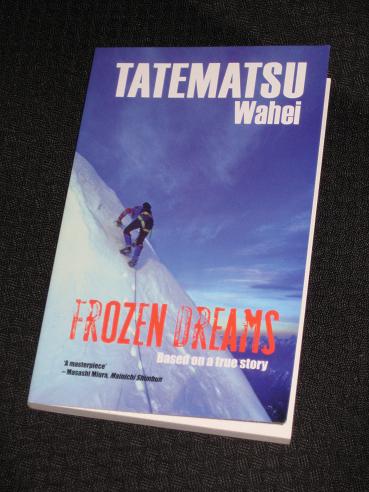
A while back, when Peter Owen Publishers offered to send me a couple of Shusaku Endo novels to review, they also asked if I would be interested in a third Japanese book by a different writer, one on the topic of mountain climbing.  I was happy to have a look, so I accepted, and the book duly appeared a few weeks later.  However, it appears that I wasn't paying attention during the e-mail exchange as what I thought was a work of non-fiction was actually a novel - which was even better :)

*****
Wahei Tatematsu's Frozen Dreams (translated by Philip Gabriel) is based on a true story but is very much a work of fiction.  It takes place in the mountains of the northernmost of Japan's four main islands, Hokkaido, and concerns a mountaineering expedition which goes horribly wrong.  Noboru, a final-year university student, is leading a six-strong team on an ascent of one the island's highest peaks.  After a few days of hard toil in sub-zero temperatures, the group digs out a snow cave to spend the night in, before recommencing their assault on the mountain the next day.  Unfortunately though, the mountain has other ideas - the assault (in the form of an avalanche) is on the climbers instead.

When Noboru wakes up, he finds himself trapped, tired and frozen in a little pocket of air.  Unable to move, he alternates between sweet dreams and painful consciousness - and in his dreams, he sees a future in which the avalanche is just a distant memory.  Having come close to Yuko, the only woman in the group, the delirious Noboru's imagination runs away with him, and he envisions a future in which he and Yuko return to the mountain, this time under a blazing sun.  Whether it will ever come true or not remains to be seen...

Frozen Dreams is an excellent glimpse into a world the majority of us will never see, the beauty and danger of mountains in the snow.  The great strength of the book is the insight into Noboru's world, a world I am more than happy to experience through Tatematsu's descriptive prose.  The writer takes us into the climbers' world, showing us how they clear the snow, dig out a snow cave, and cook in spartan conditions.  As Noboru and his group walk in the glistening snow, breathing in the crisp, clean air and gazing out over the Hokkaido landscape, it almost makes you envious.  Almost.

The climbers are well aware of the dangers they face, and in a way, this is part of the thrill.  As Noboru muses:
"But what point would there be to a climb without risk?  Even if you don't seek out danger, trying to avoid it entirely would make climbing impossible.  The more he pursued these thoughts, the more he arrived at one question: Why did one climb mountains?  It was a question nobody could answer."
p.126 (Peter Owen Publishers, 2012)
Part of the enjoyment of tackling the peaks in treacherous conditions is the knowledge that it is a gamble.  There is a lot to gain from the risk, but so much you could lose.

Naturally, Noboru's opinions are slightly altered by his experiences in the snow cave.  His dreams of a happy, married future are a far cry from his earlier feelings.
"Happiness meant monotony.  The same days one after another, time peacefully passing by, disappearing as soon as it passed.  Noboru knew he was living an ordinary life now and was happy." p.137
Unfortunately, this ordinary, happy life is all in his head...

While there's a lot to like about Frozen Dreams, it does have some drawbacks.  Despite the high profile of the translator, Murakami-renderer Philip Gabriel, there were some parts of the book which didn't impress me much.  The description of the Hokkaido landscape was beautiful, but some of the more mundane prose felt a little clunky (to use a technical term!).

I'd also have to say that the inclusion of Yuko in the group, and the resultant sexual tension with another of the climbers, seems a little forced and unnecessary.  In Noboru's series of dreams, his hopes become fantasy, culminating in some short, but slightly over-detailed, sex scenes which are completely out of place.  It's as if the writer felt a need to add another dimension to the story, one which detracts a little from Noboru's struggle for survival.

Away from bedroom matters though, it's an enjoyable read, contrasting descriptive passages of natural beauty with pages spent with Noboru in his claustrophobic bubble.  As his energy slowly dwindles (along with the batteries in his head-lamp), he is forced to face up to the worst - he (and his companions) might not make it back down the mountain alive.  And this is the motto of the story, repeated several times in its pages:
"Whenever you climb a mountain, you have to come back safe and sound.  Otherwise it's too sad for those you leave behind." p128